Inspiration
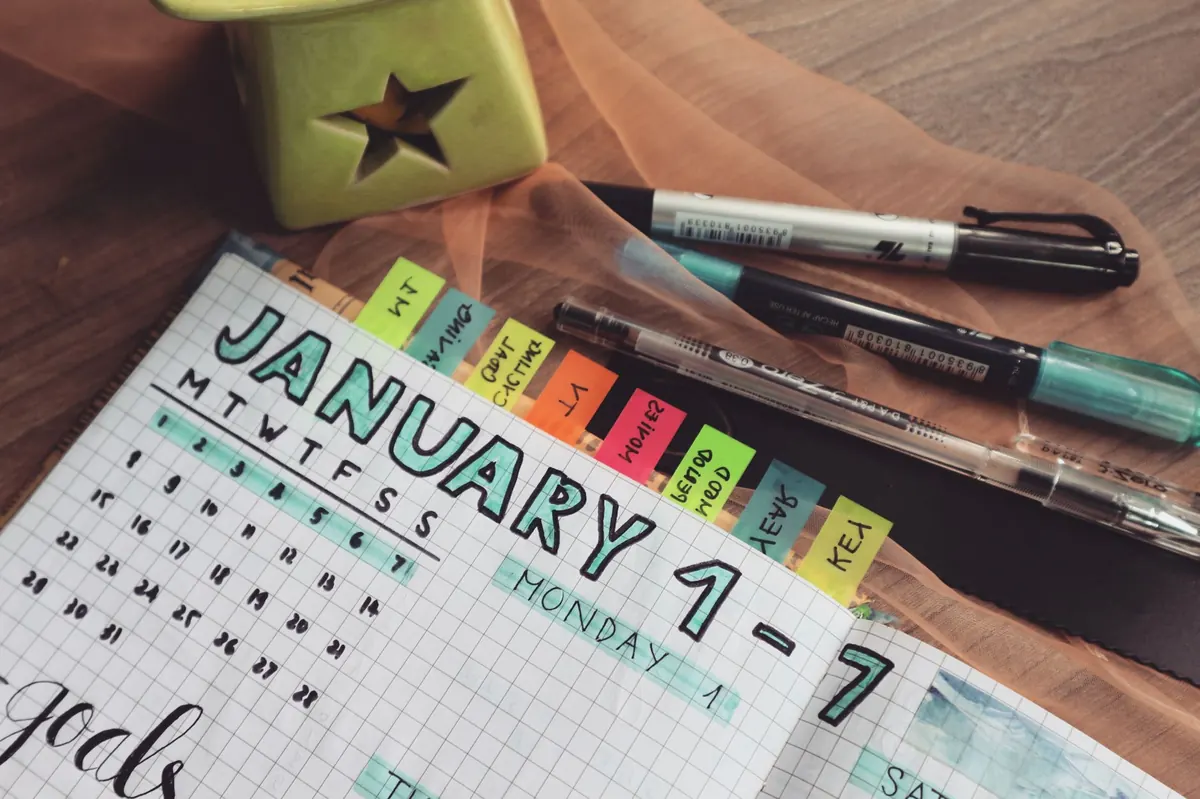
Paper Planner vs. Digital Calendar: Which One Actually Keeps You Organized?
Two people sit down on Sunday evening with the same week ahead of them. One opens a paper planner, writes Monday's three priorities in ink, and circles Thursday's dentist appointment. The other taps through a calendar app, moves a meeting, texts a partner about school pickup, and sets two reminders. Both feel organized. By Wednesday, only one of them still is.
The difference is rarely the tool itself. It is whether the tool matches how you think, remember, and recover from a messy day. Paper and digital each solve a different problem, and once you can name the problem you actually have, the choice stops being a personality quiz and becomes a practical decision.
What Paper and Digital Each Do Well
Before comparing them on memory or habits, it helps to see where each one is naturally strong.
- Paper is good at: thinking on the page, slowing you down, seeing a whole week at once, and staying free of notifications.
- Digital is good at: change, search, sharing, recurring events, alarms, and being present in your pocket at all times.
- Paper struggles with: rescheduling, anything shared with another person, and backup if you lose the notebook.
- Digital struggles with: boundaries, clutter that never forces a decision, and the fact that your calendar lives next to every distraction you own.
Notice that neither list is about being "better." They are about different jobs. A calendar app is a scheduling machine. A paper planner is a thinking surface that happens to include dates.
Memory: Why Ink Slows You Down in a Useful Way
When you type an appointment, you can copy it word for word without really processing it. When you write it by hand, you have to shorten it. That small act of compression — deciding what matters enough to fit on the line — is where the remembering happens. Many people find they recall handwritten notes better precisely because writing is slower and forces a decision.
Location matters too. A paper planner gives you a physical map: the grocery list is bottom-left, the project deadline is the top of the right page. That spatial memory is hard to replicate in a scrollable list where everything looks identical.
If you want to remember it, write it. If you want to be reminded of it, schedule it.
That single distinction resolves most of the paper-versus-digital argument. Use paper for the things you need to think through and hold in your head. Use digital for the things you simply need to be told about at the right moment.
Habits Need Visibility, Not Just Alerts
A reminder app will ping you at 7 a.m. to stretch. It will also ping you at 7 a.m. while you are pouring coffee, and you will swipe it away. The alert does its job; the habit does not happen.
Paper has an advantage here that has nothing to do with nostalgia. A habit tracker on a wall or in an open planner is ambient. You see it while walking past. You see the four empty boxes next to the three filled ones. That quiet, constant visibility does more for consistency than a notification you can dismiss without looking.
Digital is better for the other half of habits: the ones tied to time and other people. A standing run with a friend belongs in a shared calendar. A private intention to write for twenty minutes belongs somewhere you'll see it without being interrupted.
A quick test
Ask yourself: does this habit need a nudge at a specific time, or does it need to stay in front of me all week? Nudges go digital. Presence goes on paper.
Where Digital Wins Without Argument
Some things are simply not worth doing on paper. If three people need to agree on a dinner, a shared digital calendar ends the conversation. If a meeting moves twice, dragging an appointment to a new slot takes a second. If you travel across time zones, nothing else is close.
Recurring events, reminders that must fire whether or not you open a notebook, and anything you would be genuinely upset to lose belong in the cloud. Paper can't search last March. Digital can.
The Overwhelm Test
Now the part nobody mentions. A digital calendar can hold unlimited items, and that is not always a kindness. When every task, errand, and vague intention gets a slot, Tuesday becomes a wall of blocks, and you start the day already behind.
A paper planner has a natural limit: the page ends. You cannot fit forty tasks on one day spread without it looking absurd, so you are forced to choose. Scarcity becomes a feature.
Try this on a busy evening. Look at your system at 9 p.m. and notice how you feel. If you feel informed — clear on tomorrow and done with today — your setup is working. If you feel vaguely guilty, scrolling to confirm how far behind you are, the system is adding load instead of removing it. That signal matters more than any feature comparison.
Build a Hybrid You'll Actually Maintain
Most people who stick with a system long-term end up using both, with clear borders between them. Here is a version that holds up:
- Digital calendar holds commitments. Appointments, meetings, birthdays, travel, anything with a time and another person attached.
- Paper holds your intentions. Weekly priorities, a running brain dump, notes from a phone call, the three things that would make the day count.
- Do one weekly review. Fifteen minutes, same day each week. Move anything still unfinished, cross out what no longer matters, and look at the week ahead on both surfaces.
- Keep one capture point. If ideas land in six places, you have six systems and no system. Pick a notebook or a single note app for stray thoughts, then empty it during the review.
- Guard the paper time. Keep the planner open on your desk, not in a drawer. A closed planner is a diary, not a tool.
If that feels like two systems to maintain, remember that they are doing two different jobs. The friction is much lower than trying to force one tool to do everything badly.
Pick the System You'll Open on a Bad Day
The real question is not which one is more capable. It is which one you will still reach for on the morning everything goes wrong — the day you slept badly, the day a deadline moved, the day you forgot something important.
If that version of you needs a clean page and a pen to think straight, keep the paper planner and let the app handle the logistics. If that version of you needs to see the whole week change in two taps, go digital and keep a small notebook for thinking.
Pick one as your home base, use the other for what it does best, and give the arrangement a month before you judge it. Organization isn't a personality type. It's a habit of returning to the same place often enough that it starts to trust you.
Photo: Bich Tran / Pexels
Related Articles